
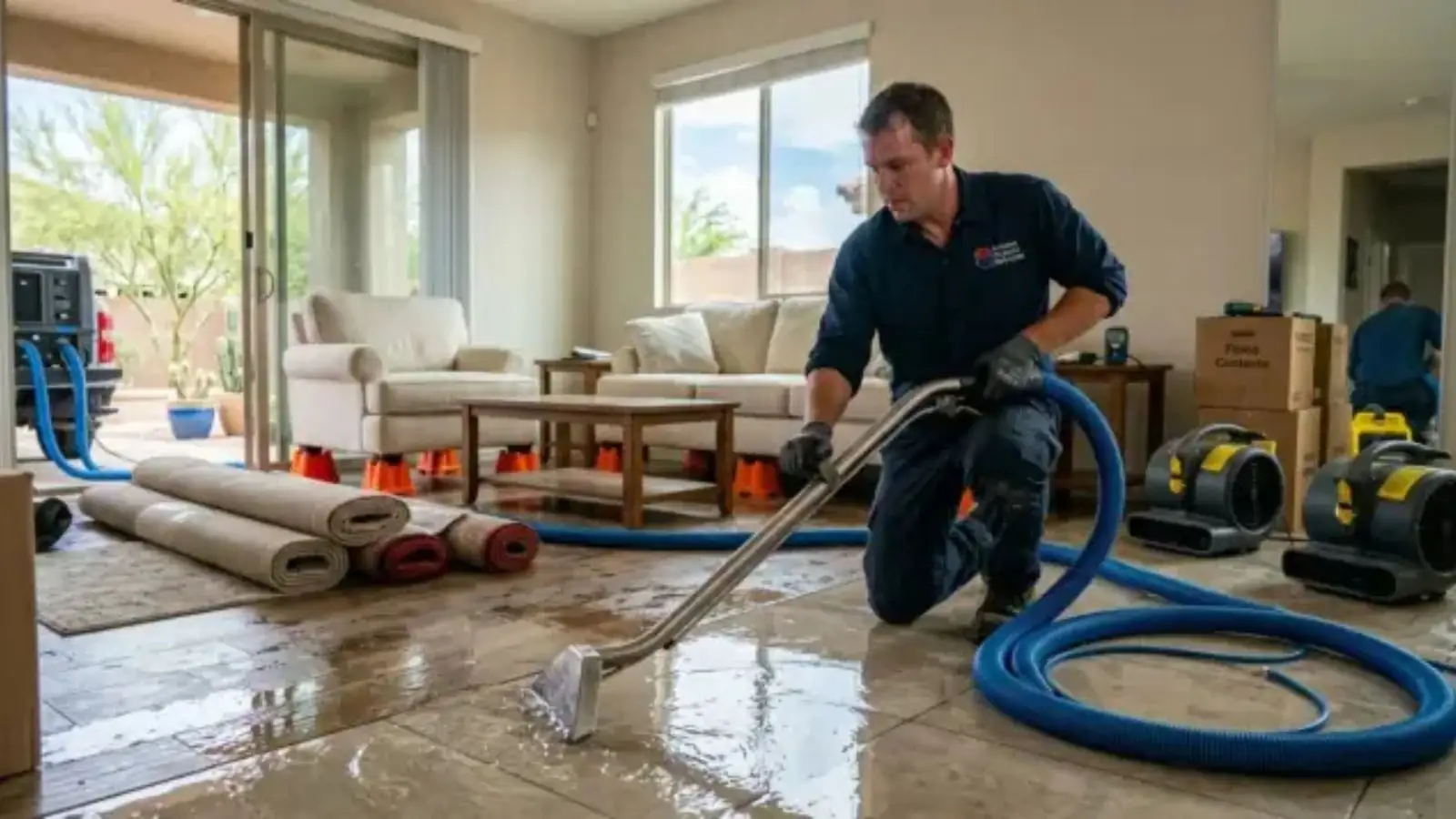
Active water, a ceiling leak or fresh mold?
The dispatch line is open around the clock, including nights, weekends and holidays.
Water Damage Restoration in Mission Hills, CA
Water damage restoration is the work of stopping the water, pulling it out of the structure, drying what can be saved and rebuilding what cannot. In Mission Hills that work starts with a phone call to a 24/7 emergency line and ends with a home that matches its pre-loss condition. This site connects Mission Hills homeowners, landlords and business owners with licensed and insured restoration professionals for water damage and the mold that follows it.
Mission Hills sits in the northern San Fernando Valley, bounded roughly by Sepulveda Boulevard and the I-405 on the west, the I-5 on the north and east, and Lassen Street on the south.
The community is part of the City of Los Angeles, so water arrives through the Los Angeles Department of Water and Power. When a main fails, as the 72-inch trunkline did on Woodman Avenue in 2019, the water does not stop at the street. It runs into yards, garages and, in some cases, living space.
Most losses are smaller and quieter than that. A supply line under a sink lets go at 2 a.m. A washing machine hose splits while the house is empty. A roof leak soaks insulation above a ceiling for days before a stain appears. All of these are time-sensitive, and the sooner a crew starts extraction and drying, the less of the house has to be torn out.
Restoration Services in Mission Hills
Emergency Water Removal
Pumps and extraction units pull standing water out of floors, carpet and low rooms now, not tomorrow. Emergency water removal in Mission Hills covers burst pipes and active flooding.
Water Damage Repair
Drywall, insulation, flooring, paint and cabinets rebuilt after the structure is dry. See water damage repair for ceilings, walls and wood floors.
Flood Damage Restoration
Storm runoff, groundwater and sewage backups need a different safety plan. Flood damage restoration covers Category 2 and 3 water.
Water Mitigation
The first 24 to 72 hours decide how much is lost. Water mitigation means shut-off, moisture mapping and drying equipment set up fast.
Water Damage Cleanup
Debris, soaked materials and contaminated surfaces are removed and sanitized. Water damage cleanup follows once the source is stopped.
Mold Remediation
Mold grows where moisture lingers. Mold remediation covers inspection, containment, removal and clearance testing.
What Mission Hills Callers Can Expect
24/7 emergency line
A person answers at any hour. Night and weekend calls are normal here, because pipes and hoses do not fail on a schedule.
Scope and price explained first
Before work starts, the scope of work, the equipment and how the price is built are explained in plain words.
Licensed and insured crews
Restoration professionals who are licensed and insured work on your property.
Documentation for your claim
Moisture readings, photos and a written scope help your insurer see what happened.
From the First Call to a Dry, Repaired Home
Call the line
Describe what is wet, where the water came from and whether it is still running.
Assessment
A technician checks moisture with meters and thermal imaging, then maps what is affected.
Mitigation
Extraction starts, then air movers and dehumidifiers dry the structure.
Restoration
Once readings are dry, damaged materials are replaced and finished.
The order matters. Rebuilding over wet framing traps moisture, and that is how a one-day leak turns into a mold job three weeks later. Each service page on this site covers one stage of the process, so you can read the one that matches where you are today.
Know What Kind of Water You Have
Restoration crews sort water into three categories under the ANSI/IICRC S500 standard for water damage restoration. The category decides the safety gear, what must be discarded and whether the job is a drying job or a disposal job.
| Category | Typical source | What it means for the job |
|---|---|---|
| Category 1 | A broken supply line, a failed water heater, an overflowing sink | Clean at the source. Dries well if started quickly, and materials can often stay. |
| Category 2 | Washing machine or dishwasher discharge, toilet overflow with urine only | Contains contaminants. Porous materials such as carpet padding are usually removed. |
| Category 3 | Sewage backup, rising floodwater, long-standing water | Grossly contaminated. Porous materials go, and crews work in protective gear. |
Clean water also ages. Category 1 water that sits for a couple of days can slip toward Category 2 as bacteria multiply, which is one more reason to call early. If you are unsure which category you have, say so on the phone and describe the source.
What Shapes the Cost of Water Damage Work
There is no honest flat number for water damage, because every loss is built from different pieces. On the first call, the scope and how the price is built are explained before any work starts, and you decide from there. These are the factors that move the total most.
Water category
Category 1, 2 or 3 changes the labor, the protective gear and how much material must be removed.
Affected area
A wet bathroom and a wet hallway, bedroom and kitchen are very different drying jobs.
Materials involved
Tile and concrete dry quickly. Carpet pad, insulation and drywall often do not.
Drying time and equipment
More air movers and dehumidifiers running more days adds to the total.
Rebuild scope
Paint and trim are one thing. New flooring and cabinets are another.
Timing
Water left standing for days spreads and raises every other factor on this list.
Insurance claims, explained in general terms
Sudden and accidental water damage is often covered by homeowners insurance, while slow leaks and neglect often are not. Flood damage is usually excluded and needs separate flood coverage. Check your policy or ask your insurer, and ask the crew to document readings and photos as they work. Want to talk it through? Call (818) 337-2642.
What Water Damage Looks Like Around Mission Hills
Water arrives in Mission Hills from the same sources it does anywhere in the Valley, plus a few local ones. Pressure from the public system matters. The 2019 Woodman Avenue break involved a trunkline that LADWP said was installed in 1914, a reminder that the pipes under the street are older than most of the houses beside them. Your own supply lines are far younger, but any line over a few decades old deserves a look.
The community has landmarks that anchor how people describe where they live. Mission San Fernando Rey de España and the San Fernando Mission Cemetery are among the best-known places in the community, while Sepulveda Boulevard is its main commercial road. Shops and restaurants along Sepulveda face the same sprinkler, water heater and plumbing failures as homes, with the added pressure of getting back to business. Mention that on the call so the drying plan can account for it.
Care facilities and schools also depend on dry buildings. Providence Holy Cross Medical Center, the new Kaiser Permanente in the area and Bishop Alemany High School are neighbors to many homes here. If your property is close to any of them, give dispatch the nearest cross streets so the crew can plan the route. Three freeways meet around Mission Hills (I-5, I-405 and SR-118), and traffic on them affects how quickly anyone can reach a job.
Flood exposure varies block by block. Before storm season, check the FEMA flood map for your address and ask your insurer about flood coverage, because standard homeowners policies do not pay for flood damage. For permit questions on a rebuild, ask the Los Angeles Department of Building and Safety, since permit rules vary by the kind of work.
What to Do While You Wait for a Crew
Stop the source
Shut off the main water valve if you can reach it. Most homes have one near the street side or at the water heater.
Mind the electricity
Turn off power to wet areas only if the panel is dry and safe to reach. If water touches outlets or the panel, stay out and call the utility or 911 first.
Lift and protect
Move small furniture, electronics and paper off wet floors. Pull rugs if they come up easily.
Keep people clear
Keep children and pets out of any water that may be contaminated, including sewage or floodwater.
Take photos and short videos before moving things, because they support an insurance claim later. Then call (818) 337-2642 and the dispatcher will walk through the next steps. Do not run a household vacuum on standing water and do not use heaters to dry soaked rooms.
Mission Hills and Nearby San Fernando Valley Towns
Beyond Mission Hills, the same 24/7 line covers five nearby places. Each has its own page with local details, so read the one that matches your address.
North Hills and Van Nuys fall under the Panorama City page, Northridge under Granada Hills, Sun Valley under Pacoima and Lake View Terrace under Sylmar. A full list is on the service areas page.
Water Damage Questions in Mission Hills
How soon should I call after I find water damage?
As soon as you find it. The first 24 to 48 hours decide whether drywall and framing can be dried in place or must be cut out. Calling at night is fine because the line is staffed 24/7.
Do you handle emergencies at night and on weekends in Mission Hills?
Yes. The emergency line is open 24 hours a day, every day, and dispatch sends a crew the same day when one is available. A burst pipe at 3 a.m. gets the same attention as a Tuesday morning call.
Will my homeowners insurance cover the work?
It depends on your policy and on the cause. Sudden and accidental damage is often covered, gradual leaks often are not, and flood damage usually needs separate flood coverage. Ask your insurer, and ask the crew to document moisture readings and photos for the claim.
How does pricing work?
The scope of work and how the price is built are explained before work starts. The main factors are water category, affected area, materials, drying days and rebuild scope. For your own situation, call (818) 337-2642.
Is water damage restoration the same as waterproofing?
No. Restoration repairs damage after water gets in, while waterproofing tries to keep water out of a foundation or basement. If water keeps coming back through a foundation, the fix is a waterproofing or drainage trade, and we will say so honestly.
Can you handle mold that appeared after a leak?
Yes. Mold needs moisture, so the leak must be fixed first. Our mold remediation page explains inspection, containment, removal and clearance testing following the ANSI/IICRC S520 standard.